Mr. Wilner
The Captain and Ann BarbaraMr. Wilner appears in Mary Antin's account as the partner of her father, Joseph Antin, in a refreshment stand at Crescent Beach, and he is remembered with an intensity that borders on worship. He is the man who makes potato chips unlike any others on the beach—thin as tissue paper, crisp as dry snow, and salt as the sea—and he performs his craft with such theatrical flair that the young Mary Antin could stand for an hour at a time just watching him. In his cook's cap and apron, with a ladle in his hand and a smile on his face, he moved about with the greatest agility, whisking his raw materials out of nowhere, dipping into his bubbling kettle with a flourish, and bringing forth the finished product with a caper. He is the embodiment of American energy and showmanship, a figure who transforms the humble trade of frying potatoes into a spectacle of skill and charm.
Identity and Household
Mr. Wilner is introduced not only as a business partner but as the head of a remarkably large and lively family. He kept his little wife and their many children in the little cottage next to the Antins' home, and the shanty's survival amid the tumultuous presence of that brood is described as a wonder. The young Wilners included an assortment of boys, girls, and twins, of every possible variety of age, size, disposition, and sex. They swarmed in and out of the cottage all day long, wearing the door-sill hollow and trampling the ground to powder; they swung out of windows like monkeys, slid up the roof like flies, and shot out of trees like fowls. So numerous and so constantly in motion were they that Mary could never tell which Wilner she had encountered, partly because none of them ever stood still long enough to be identified and partly because she suspected they habitually interchanged conspicuous articles of clothing. Despite this chaos, Mrs. Wilner ruled her brood with the utmost coolness and strictness, keeping even the biggest boy under her thumb. At five o'clock in the evening, on seven days in the week, the twelve little Wilners could be seen in two long rows around the supper table, all with their faces washed—the only occasion on which they could be counted and told apart.
The Potato-Chip Artist at Work
At the refreshment stand, Mr. Wilner's skill was the centerpiece of the family enterprise. His potato chips were not to be had anywhere else on Crescent Beach, and their quality—thirst-producing, lemonade-selling, nickel-bringing—made them the stand's great attraction. On holidays, when dozens of family parties came out by every train from town, he could hardly keep up with the demand. With a waiting crowd around him, the partner was at his best: as voluble as he was skilful, and as witty as he was voluble, at least so Mary guessed from the laughter that frequently drowned his voice. She could not understand his jokes, but if she could get near enough to watch his lips and his smile and his merry eyes, she was happy. That anyone could talk so fast, and in English, was marvel enough, but that this prodigy should belong to their establishment was a fact to thrill her. She had never seen anything like Mr. Wilner, except a wedding jester—but then a wedding jester spoke common Yiddish, while Mr. Wilner performed in English. So proud was she of the talent and good taste displayed at their stand that when her father beckoned to her in the crowd and sent her on an errand, she hoped the people noticed that she, too, was connected with the establishment.
The Partnership and Its End
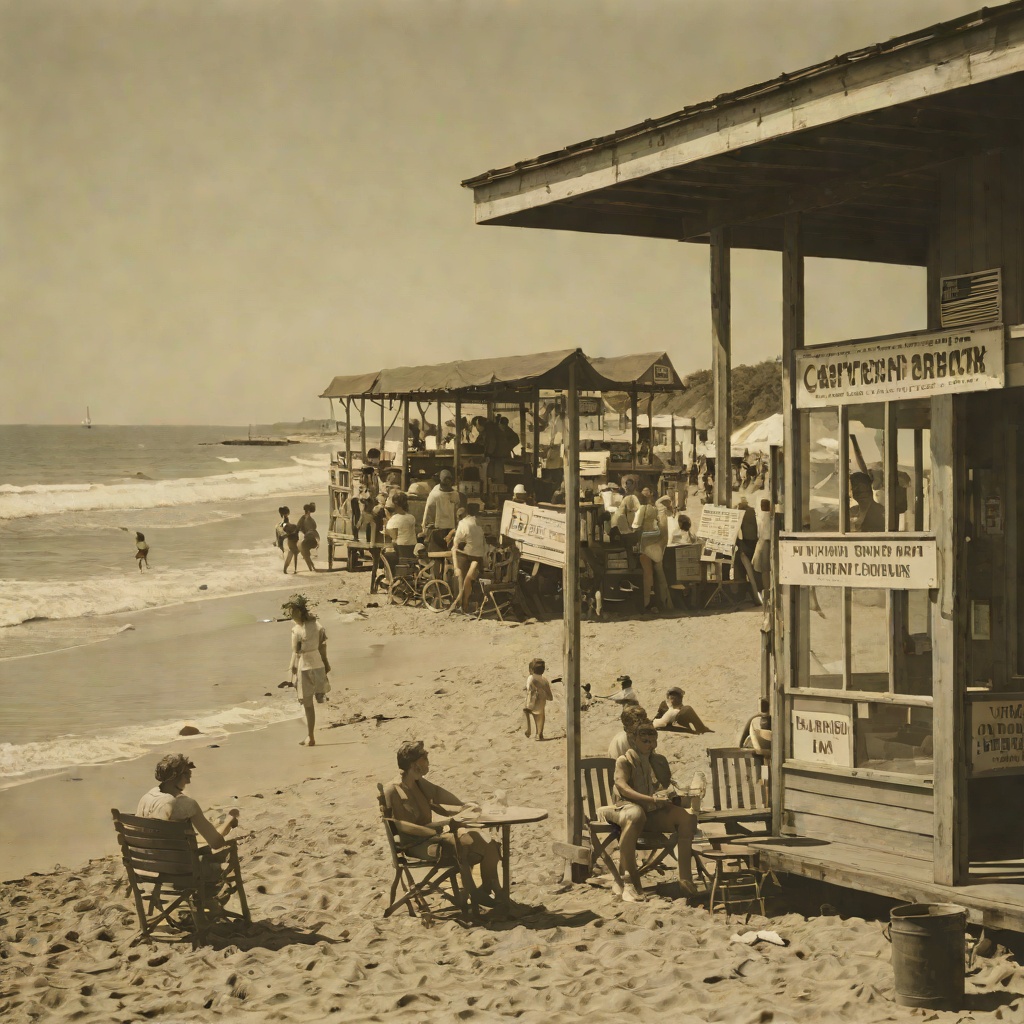
Mary's admiration extended to the whole enterprise. She admired greatly the shining soda fountain, the rows of sparkling glasses, the pyramids of oranges, the sausage chains, the neat white counter, and the bright array of tin spoons, and she thought none of the other refreshment stands on the beach were half so attractive as theirs. She thought her father looked very well in a long white apron and shirt sleeves, and she supposed he was getting rich as he dished out ice cream with enthusiasm. It never occurred to her to compare his present occupation with the position for which he had been originally destined; or if she thought about it, she was just as well content, for by this time she had by heart her father's saying, "America is not Polotzk." All occupations were respectable, all men were equal, in America. This idyllic arrangement came to a sudden end. There was some trouble about a license—some fee or fine—there was a storm in the night that damaged the soda fountain and other fixtures—there was talk and consultation between the houses of Antin and Wilner—and the promising partnership was dissolved. No more would the merry partner gather the crowd on the beach; no more would the twelve young Wilners gambol like mermen and mermaids in the surf. The less numerous tribe of Antin must also say farewell to the jolly seaside life, for men in such humble business as Mary's father carried their families, along with their other earthly goods, wherever they went, after the manner of the gypsies. They had driven a feeble stake into the sand; the jealous Atlantic, in conspiracy with the Sunday law, had torn it out.
Significance in the Narrative
Mr. Wilner functions in Mary Antin's memoir as a vivid emblem of the American promise as it appeared to a child immigrant. His rapid English speech, his theatrical skill, and his enormous, boisterous family all represent the vitality and abundance that America seemed to offer in contrast to the constrained life of Polotzk, where Mary had already begun to be considered too old for play. The dissolution of the partnership, brought about by a license dispute and a storm, marks the first of several forced relocations in the Antin family's American journey. In Polotzk they had supposed that "America" was practically synonymous with "Boston"; when they landed in Boston, the horizon was pushed back, and they annexed Crescent Beach; and now, espying other lands of promise, they took possession of the province of Chelsea, in the name of their necessity. Mr. Wilner's brief but brilliant appearance thus encapsulates both the exuberance of the immigrant's first encounter with American opportunity and the precariousness of that opportunity, subject as it was to licenses, fees, storms, and the Sunday law.